
If your Volvo D5 has gone flat, dropped into limp mode, or started blowing smoke, the answer is almost never as simple as "it needs a turbo". Volvo has put the D5 badge on two completely different diesel engines. The newer of the two has two turbochargers, plus a compressed-air system that can fail on its own and feel exactly like a failed turbo. Before anyone buys a part, the job is to work out which engine is in the car and which of several cheaper faults is actually causing the symptom.
We are an independent used-parts supplier and are not affiliated with, endorsed by, or authorised by Volvo Car Corporation or AB Volvo.
The D5 badge covers two different engines
This is the single most useful thing to get straight, because it decides which parts even fit.
The older D5 is a 2.4-litre five-cylinder diesel, fitted across the S60, S80, V70, XC70 and the first-generation XC90. The newer D5 is a 2.0-litre four-cylinder from Volvo's VEA family, and it is a very different thing. Published engine-code data describes this version, engine code D4204T23, as having "Twin turbochargers, one with VNT" and being "Equipped with PowerPulse".1 PowerPulse itself arrived with the S90 in 2016, described as an "anti-lag system for the top of the range diesel engines".1
And it gets one step worse, because the turbo count does not follow the badge either. Volvo's own press material describes the 205hp five-cylinder D5 launched in the S80 at the end of 2008 as using "a twin-turbo setup with two different-sized turbochargers operating in tandem".5 So some late five-cylinder cars are twin-turbo too.
But not every late five-cylinder went that way. The published engine-code table shows the 205 PS D5244T10 with a "Two-stage" turbo arrangement, while the 200 PS D5244T18 of the same era is still listed as "VNT" — a single variable-nozzle turbo.6 Two engines of near-identical output, both wearing a D5 badge, with different turbo hardware.
The practical upshot: "2010 Volvo D5" tells you almost nothing. The engine code decides how many turbochargers you have, and the badge does not carry the engine code. "I need a turbo for my D5" is an ambiguous sentence, and ordering against the wrong one is an expensive mistake. The VIN is the only thing that settles it.
The 2.0 D5 has a big turbo and a small one
On the twin-turbo D5 the two units do different jobs at different engine speeds, which is why "the turbo" is not a precise enough diagnosis. An experienced contributor on the UK Volvo Owners Club forum sets the layout out plainly: "The 'big' turbo is the lower one, This is the low pressure turbo that comes in around 2-2.5k rpms. The 'small' one is the high pressure that comes in straight away."2
On which one usually fails, the evidence lines up. That contributor goes on to say the small, high-pressure turbo is "usually the one that fails as its always under stress", and that "both turbos are bolted together and come out as one."2 An independent reliability database agrees on which one goes. It records "high-pressure turbo problems at higher mileage: loose turbine shaft, oil in the air pipe, in severe cases turbine wheel collapse often after oil starvation."7
The same database adds that debris from a failing turbo can contaminate the second turbo and the intake tract.7 So service history matters more than mileage, and a workshop should say which unit it has condemned, and what state the other one is in, rather than writing "turbo".
A failed actuator is not a failed turbo
This is where money gets wasted. In that same thread, the owner of a December 2017 V90 D5 reported the car "off the road for a week or so now with Volvo wanting to replace the entire turbo unit at a ridiculous cost", while an independent workshop's reading was that "it's just the actuator that's gone".2
The actuator is the part that moves the variable vanes or the wastegate. It can fail while the turbo's core is perfectly healthy. Ask the workshop to say explicitly whether they have condemned the cartridge or the actuator, and which of the two turbos they mean, before anyone orders anything.
And there is more than one kind of actuator across these engines, which is another reason not to order on a badge. Volvo's second-generation five-cylinder D5, from 2005, is documented as having "a water-cooled VNT turbocharger with a bigger compressor and an electric servo motor to adjust the vanes".6 Yet a published diagnostic case study on a 2005 S80 2.4 D5 works by "plumbing a vacuum gauge on the solenoid output line" to read the pressure applied to the actuator.8 That method only works on a vacuum-operated actuator. So both types are out there. Confirm which your car has rather than assuming.
A bang, then it just feels flat: the PowerPulse hose
PowerPulse stores compressed air and releases it to spin the turbo up quickly. The hose that carries that air is, on the evidence of owners, a weak point.
Owners on the UK Volvo Owners Club forum describe the failure in consistent terms. One XC90 D5 owner reported a "massive explosion" three weeks after delivery, then the loss of "low down grunt, and 'kick'" when overtaking, with no warning lights at all. The same owner had a second failure weeks later, described as a "deafening detonation from the drive way" with the car parked. A V90 D5 owner in the same thread heard "a big bang, like an explosion" while driving through a tunnel.3
The detail worth carrying away is what one dealer is quoted as telling an owner: "We frequently replace these pipes. Generally the drivers don't even notice the reduced performance, and we replace them when the cars come in for servicing."3 A car can be driving around with this fault and simply feel a bit dull, with nothing on the dashboard to explain it.
An independent reliability database describes the same weak point and offers a reason. It reports that the hose "tears under temperature and pressure cycling and sometimes fails again even after replacement, because working pressure and hose maximum pressure sit too close together."7 Note the sting in that. A replacement is not guaranteed to be the end of it.
The first check costs nothing. One owner in that thread suggests listening under the bonnet "immediately after switching the engine off for a hissing sound".3 Have the hose inspected before condemning anything expensive.
Before you buy a turbo, rule these out
Lost boost, limp mode and odd noises all point at the turbo, and often the turbo is innocent. Worth eliminating first:
- The PowerPulse hose, on 2.0 D5 engines fitted with it. A known weak point on owner evidence, and it produces exactly the dull-off-the-line feel people blame on a turbo.
- Split or leaking charge pipework. On a Volvo forum discussion of D5 noises, one contributor notes that "turbo pipes eventually split" and produce "whooshing and hissing noises".4 A boost leak starves the engine of air just like a failing turbo does, and it is a pipe, not a turbo.
- The EGR valve. In that same thread, an owner chasing a loud "popping noise coming through the air pipe which goes to the turbo unit" on a 2007 XC90 D5 was later reported by another member to have found the EGR valve was the problem, not the turbo.4 The noise came through the turbo plumbing, which is precisely why it misleads.
- Sticking vanes rather than a dead turbo. A published diagnostic case study on a 2005 S80 2.4 D5 describes how "carbon deposits build up around the vane mechanism causing it to seize", and reports that the vane mechanism was "more prone to failing at cool engine temperatures."8
- A control-side fault rather than the turbo at all. The same study reports that its measurement method "flushed out leaking solenoid valves, and a blocked solenoid waste outlet line - all giving symptoms of a seizing turbo when viewing live data through the scan tool."8
- The actuator rather than the turbo itself, as above.
One symptom worth recognising, because it is unusually specific. In that case study the classic pattern is an overboost condition the engine management logs before dropping the car into limp mode, where "cycling the key off and on again will usually restore power until the next fault event."8 Power that comes back after a restart, and a fault that is worse first thing on a cold morning, both point at a sticking mechanism rather than a destroyed turbo.
None of this means turbos do not fail on these engines. They do, and a seized impeller is a real outcome. It means the diagnosis needs to name a part, not a symptom — and it means finding out why it failed. Where the reliability data names a cause for these failures, it is often oil starvation,7 so fitting a replacement without addressing the oil supply is how people buy the same part twice.
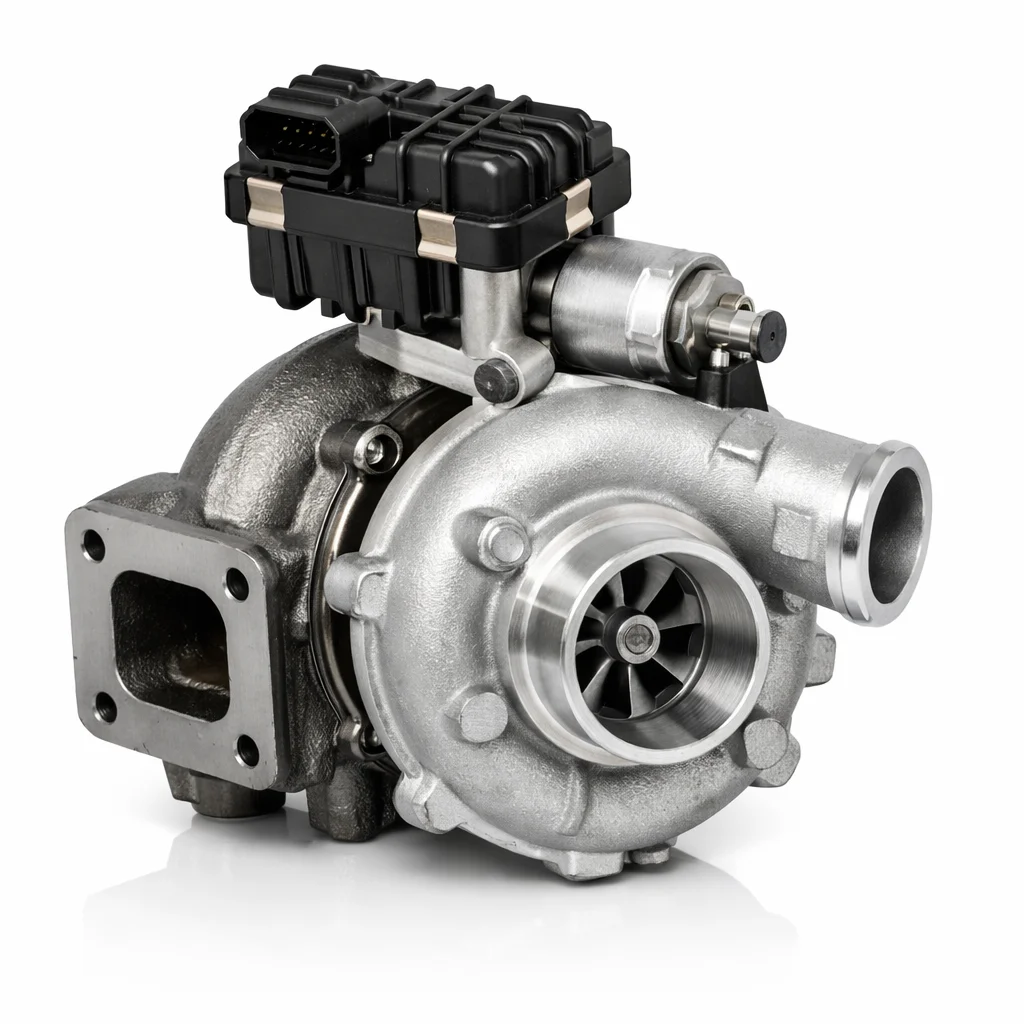
Related parts
Turbochargers for the five-cylinder D5
The variable-geometry unit fitted to the older 2.4 five-cylinder diesel in the S60, S80, V70, XC70 and first-generation XC90. Tell us the registration or VIN and what the workshop actually condemned, and we will confirm the right unit before quoting.
Indicative image. Stock varies, so the unit you are quoted may differ in appearance.
How to tell which D5 you actually have
Three checks, quickest first.
| Check | What it tells you |
|---|---|
| Count the cylinders | The only quick check that is reliable. Five means the older 2.4-litre engine; four means the 2.0-litre. Everything else follows from this. |
| Model year | A useful hint, not an answer. The older five-cylinder ran through the first-generation XC90, S80, V70, XC70 and S60 era; the 2.0-litre arrived around 2015. |
| The D5 badge | Tells you nothing on its own. It has meant both engines, and it does not indicate how many turbochargers are fitted. |
| The VIN | The only thing that settles it outright, including which turbo arrangement your specific car left the factory with. |
We have deliberately not listed every model and year here. The changeover years are exactly where mistakes happen, and a table confident enough to be useful would be confident beyond what we can prove. Send the VIN and we will check it rather than guess.
What to send us when you ask for a price
The more of this you can supply, the better the chance of getting the right part first time:
- The VIN, which identifies the engine unambiguously.
- Which part was condemned, in the workshop's own words: turbo cartridge, actuator, PowerPulse hose, EGR valve.
- Which turbo, if the car is a 2.0 D5: the low-pressure unit or the high-pressure one.
- Any fault codes that were read, exactly as they appeared.
Our used Volvo turbochargers are pulled and checked in Durban North and couriered nationwide. If the diagnosis turns out to point further into the engine, we also carry complete used Volvo engines and cylinder heads. Model pages for the XC90, XC60, S60 and S80 list what else we hold for each car.
Frequently asked questions
Does my Volvo D5 have one turbo or two?
You cannot tell from the badge, and this catches people out. Most 2.4-litre five-cylinder cars use a single variable-geometry turbo, but Volvo introduced a twin-turbo five-cylinder in the S80 at the end of 2008. The 2.0-litre four-cylinder D5 from around 2015 has two turbochargers, and the later D4204T23 version adds the PowerPulse compressed-air system. The VIN is the only reliable answer.
Can the actuator be replaced without replacing the whole turbo?
The actuator is a separate component from the turbo cartridge, and owners have reported a main dealer quoting for a complete turbo where an independent workshop identified only the actuator as faulty. Whether it can be replaced on its own depends on the specific unit and on what else has worn, so ask the workshop to state clearly which part they have condemned.
My car feels flat but there are no warning lights. Can it still be a turbo problem?
Yes, and it can also be something much cheaper. Owners have described a burst PowerPulse hose producing a loss of low-speed pull with no warning light at all, and one dealer is reported as saying most drivers do not even notice the reduced performance. A boost leak from split charge pipework behaves the same way. Have those checked before assuming the turbo has failed.
Is a used turbocharger a sensible buy for a D5?
It can be, provided the fault has actually been traced to the turbo and not to an actuator, a hose or the EGR valve. The risk with a used turbo is buying one to fix a problem it was never causing, which is why we ask what the workshop condemned before we quote.
What causes a turbo to fail on these engines?
Oil starvation is the cause the reliability data names most often, which is why service history is worth more than mileage when judging a used car. On the twin-turbo 2.0 D5, both an experienced owner and an independent reliability reference point at the small high-pressure turbo as the one that fails, and debris from a failing turbo can contaminate the second turbo and the intake tract. A replacement fitted without finding the original cause can fail again.
Sources
- Wikipedia, Volvo Engine Architecture — engine-code detail for the D4204T23 and the introduction of PowerPulse with the S90 in 2016.
- Volvo Owners Club forum, "D4204T23 - Actuator for turbo broken, but what turbo?" — turbo layout, actuator versus cartridge, and impeller seizure.
- Volvo Owners Club forum, "D5 PowerPulse pipe burst again..." — owner accounts of PowerPulse hose failures and the reported dealer comment.
- PistonHeads, "What Is This Air Popping Noise in My D5 Engine?" — a noise through the turbo pipework traced to the EGR valve, and discussion of split turbo pipes.
- Volvo Car Corporation press release, archived by the Volvo Owners Club UK, "D5 upgraded" — the manufacturer's own description of the sequential twin-turbo five-cylinder D5 introduced in the S80 at the end of 2008.
- Wikipedia, Volvo D5 engine — the engine-code table showing D5244T10 as two-stage against D5244T18 as VNT, and the 2005 second generation's electric servo motor for the vanes.
- What-Breaks, Volvo XC60 (Mk2) used-car weakness database — PowerPulse hose failure and recurrence, and high-pressure turbo failures after oil starvation.
- Pico Technology, "Variable nozzle turbine - VW Golf 1.9 TDI & Volvo S80 2.4 D5" — a diagnostic case study covering vane seizure, cold-engine bias, the key-cycle limp-mode pattern, and control-side faults that mimic a failing turbo.